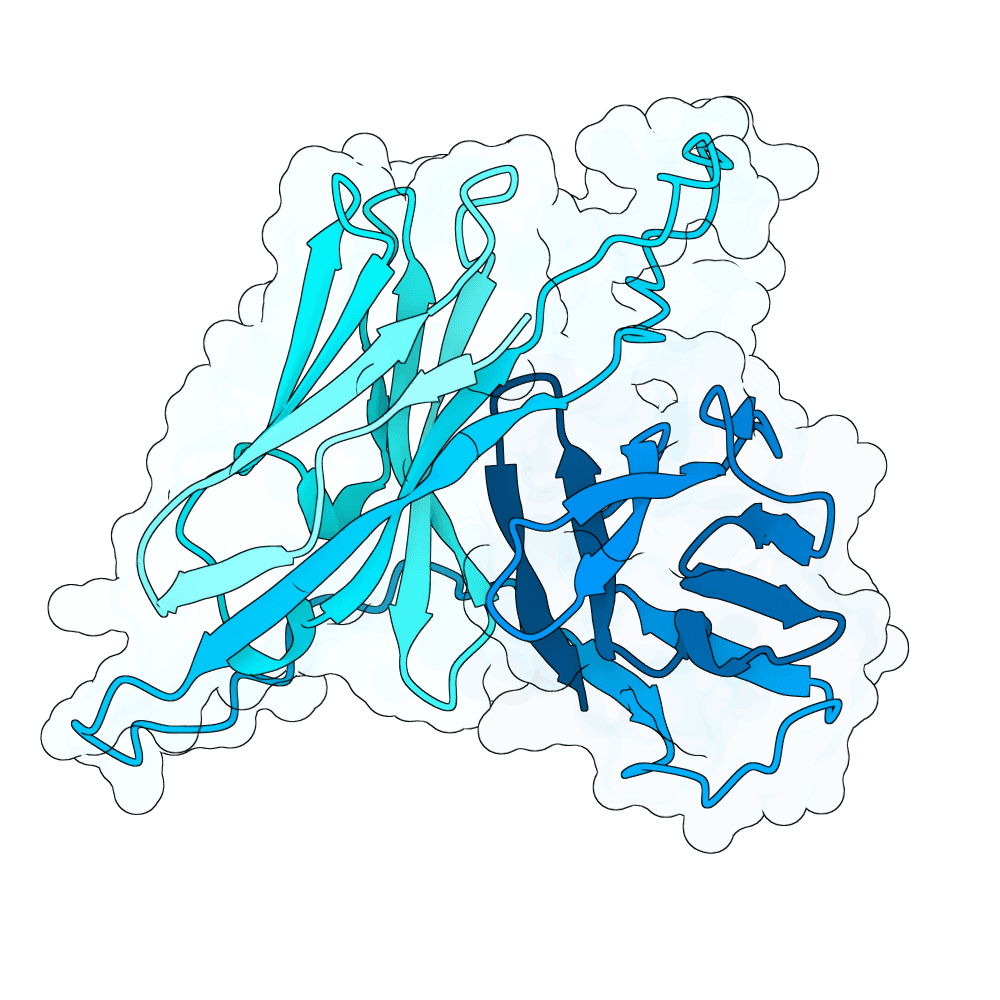
We start from the pre-existing antibody–receptor complex structure 6CMI, which contains an antibody against Hendra virus bound to its receptor binding protein (RBP). Because Hendra and Nipah RBPs are highly related, we structurally align the Hendra RBP (from 6CMI) with the Nipah RBP and use this alignment to identify conserved or structurally similar interface residues on the viral RBP that should be preserved or strengthened in our designs.
Using this alignment, we define the design region on the antibody as the heavy-chain CDRs while keeping the antibody framework and other CDRs as close as possible to the original 6CMI variable light chains (same CDR lengths). We then build a Nipah-specific complex model by predicting Nipah RBP in complex with the 6CMI-based antibody using AlphaFold3, and use this model as the input for structure-based design.
On this complex, we apply RFdiffusion in a local inpainting / binder-design mode focused on CDRHs, preserving loop length and freezing the rest of the antibody and antigen. The resulting backbones are then passed to ProteinMPNN, where only CDRHs positions are allowed to mutate while framework and non-target CDR residues remain fixed to the 6CMI sequence.
To evaluate and rank designs, we run Boltz-2 to generate structural ensembles for each antibody–Nipah RBP complex and compute ipSAE and related interface scores on every model. We observed substantial variability in ipSAE across Boltz-2 models for the same sequence (e.g., ~0.1 vs ~0.7), so we rank designs based on ensemble statistics (e.g., best/mean ipSAE across 5 models) instead of a single prediction.