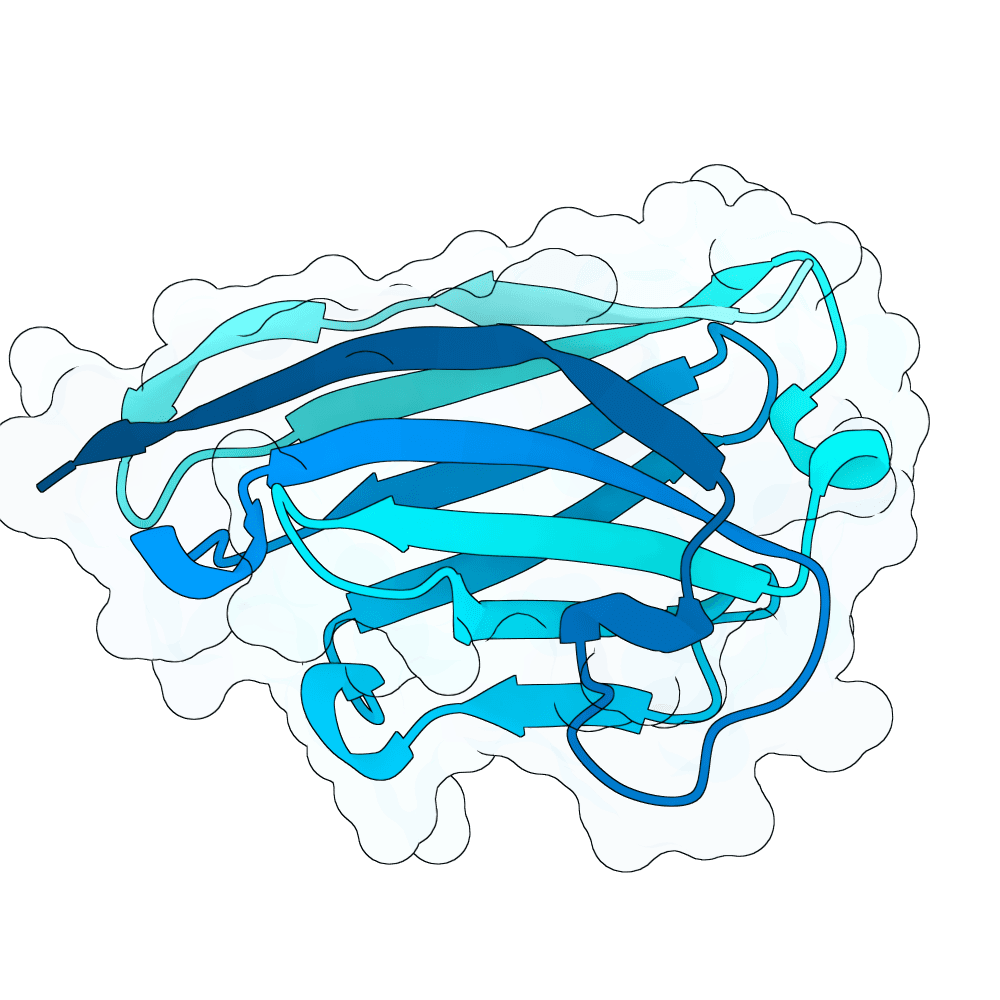
Starting from the three-dimensional structure of the Nipah virus obtained from PDB, we proceed by performing protein-protein docking of a generic single-chain antibody (VHH or Camelid) on the chosen protein target. In this phase, we choose the antigenic epitope to target. Using RosettaDocking, 5,000 different docking poses are generated. The software generates a scoring file with the scores assigned to each individual pose generated. The interaction surface (each atom of the two structures at a distance of less than 6 angstroms from its counterpart) is extracted from the structures generated. The docking results are then subjected to a software filter to determine the structures that interact with the amino acid residues that make up the chosen epitope. Subsequently, the structures obtained from the first filter are sorted according to two parameters generated by the RosettaDocking score function: total_score and I_sc. The first represents the stability of the protein complex (the more negative, the better the pose), while the second represents the interaction energy of the two proteins (as in the first case, the more negative the better the pose). The docking pose with the best total_score and I_sc is chosen for the next design phase.
The antibody design is carried out using RosettaAntibodyDesign. The software accepts protein complexes (between an antibody and a target protein) produced by docking or as a result of X-ray or other protein imaging techniques. RosettaAntibodyDesign consists of two Monte Carlo cycles nested within each other. The software uses a database of known CDR clusters that it attempts to insert into the structure of the starting antibody in order to find the combination of CDRs that increases the binding energy with the antigenic target. The aim is to mimic the V(D)J recombination that antibodies undergo during affinity maturation in the human body. In the absence of suitable CDR structures, it designs the CDR starting from the sequence entered, implementing point mutations in the sequence in order to improve the binding energy. At the end of the design procedure, RosettaAntibodyDesign generates N different structures and a scoring file with the energy scores for each structure produced. The terms taken into consideration are: total_score (which, as in the previous case, indicates the stability of the complex) and dG_separated (which in this case represents the bond delta G). To select the structure with the best energy, the scoring file is sorted according to total_score, selecting the top 25% of structures with the highest energy and then sorting the filtered list according to dG_separated, thus selecting only those designs that have an acceptable total_score. At this point, the structure with the highest dG_separated is chosen for subsequent in-silico analyses (such as MMPBSA and similar) and then expression and in vitro binding assays.