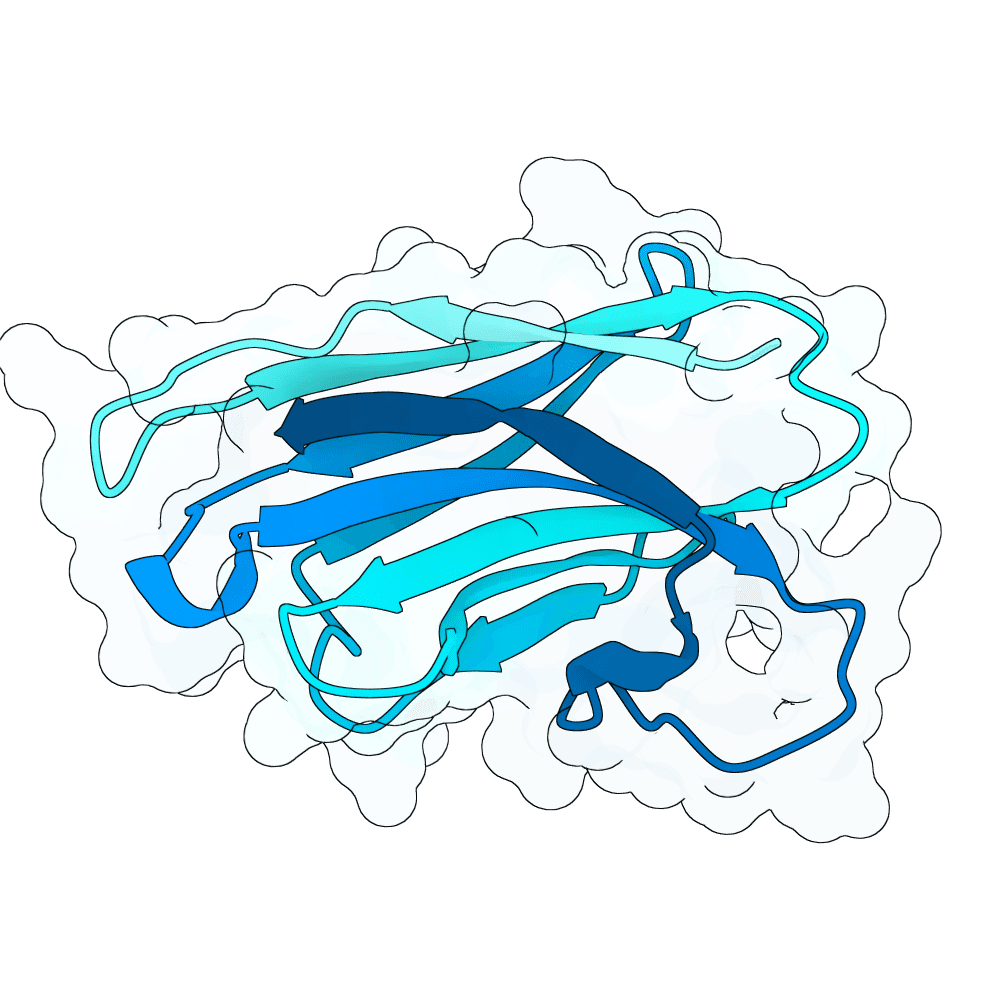
This method uses a slightly adapted version of BoltzGen to generate initial nanobody-antigen docked structures, which are then optimized using EvolveX, a proprietary structure-based antibody optimization pipeline (https://www.biorxiv.org/content/10.1101/2024.04.22.589762v2).
BoltzGen code was adapted to sample VH-CDR1/2/3 lengths that better match the observed distribution in natural nanobodies than the provided default CDR lengths for the 4 scaffolds found in the BoltzGen repository. We generate 20k designs and 5 inverse folding models per design. The resulting 100k BoltzGen designs were ranked by ipTM, and only 2 of them (names: 0355 & 0317) with an ipTM ~0.80-0.85 were selected as they seemed to bind near the binding region of the natural ligand shown in PDB 2VSM. Note that we did not manage to generate any structure with an ipTM above 0.85, which is typically associated with a pDockQ score < 0.1.
The 2 candidate docks were then run through EvolveX to optimize them, effectively acting as an alternative inverse folding model than BoltzGen's. Briefly, EvolveX is a multi-objective, structure-based optimization pipeline that leverages FoldX and other physics-based scores to optimize antibody CDRs through a simple Monte Carlo search that introduces single points mutations to a set of input PDB structure. Given FoldX's sensitivity to the backbone of the input PDB files, we generated 10 structures with Boltz-2 with default --step_scale, and another 10 with --step_scale=1, so 20 input structures per EvolveX run. We then filter the resulting EvolveX generated designs using physics-based scores such as FoldX predicted binding affinity, shape complementarity, net charge, or TANGO predicted aggregation; the threshold of each filter is selected based on its observed distribution in high-resolution nanobodies from sabdab. Finally, the remaining filtered EvolveX designs (typically < 30k) are refolded using Boltz-2, and the predicted structures are used to compute min_ipSAE and the RMSD with respect to the original BoltzGen dock. We set the RMSD threshold to 2.0A, rank by min_ipSAE, and submitted the top 10 designs of each of the 2 docks.