Description
My design objective was to create small, stable, de novo peptides capable of blocking the interaction between the Nipah virus attachment glycoprotein G (NiV-G) and its human receptors Ephrin-B2/B3. The crystal structure 2VSM reveals that NiV-G relies on a deep hydrophobic cavity that accommodates Ephrin’s Trp125 residue. This pocket is a key vulnerability: if sterically occluded or energetically disrupted, viral attachment cannot occur. Based on visualization of the crystal structure in PyMOL, UniProt annotations, and literature data, I focused specifically on residues Cys238–241, Arg242, Ile401, Arg402, Gln490–Ser491, Trp504, and Val507—the hydrophobic “canyon” lining the Trp125 insertion pathway.
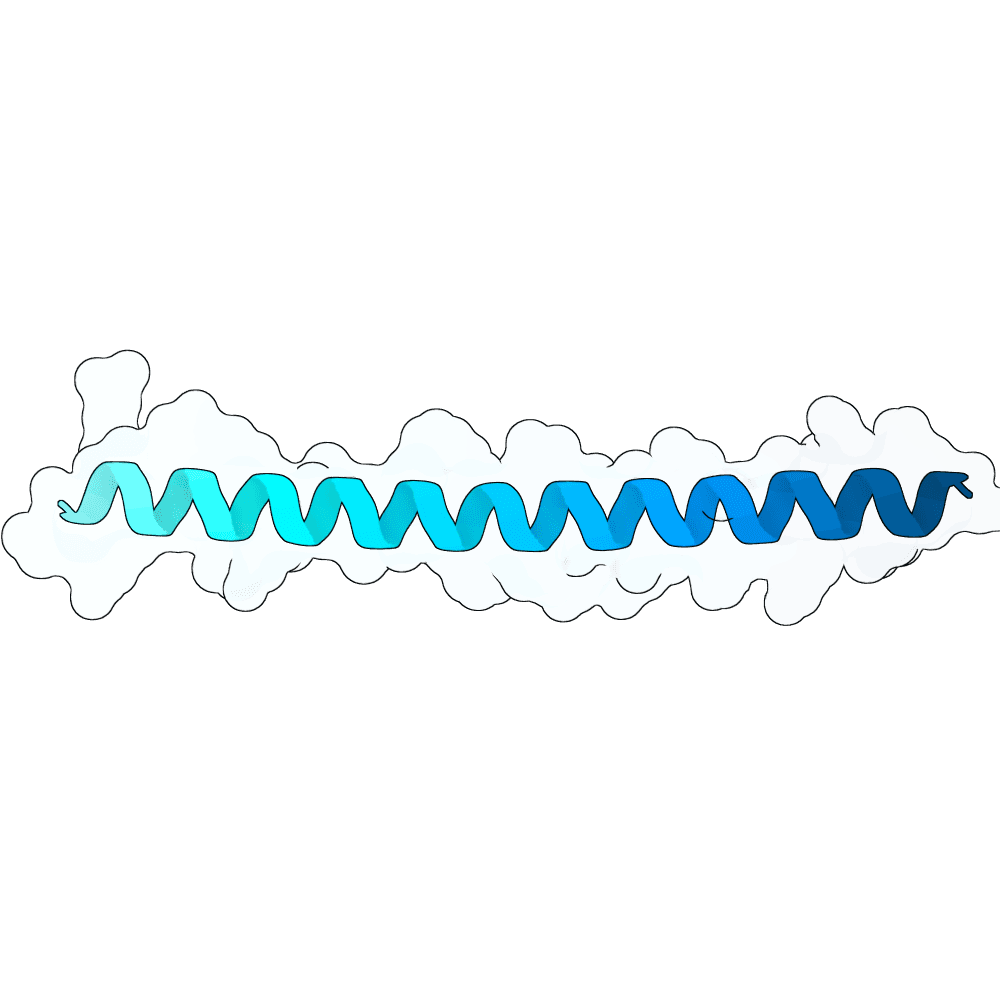
I used an AI-assisted, hybrid design strategy that combined mechanistic reasoning, classical physics-based tools, and sequence-level generative design. I designed single long amphipathic α-helices (≈48–55 aa) that remain highly rigid, each incorporating a strategically positioned aromatic motif (W/F/Y) capable of inserting into the pocket. The peptides were conceived as surface “riders”: they should remain outside the cell, close to but not embedded in the membrane. The amphipathic design ensures moderate membrane affinity while maintaining solubility and avoiding membrane-insertion motifs.
AI reasoning (LLM-assisted pattern optimization) was used to generate and refine amphipathic helices with high helical propensity (A/L/E/K/Q-rich), balanced charge distribution, and optimized placement of aromatic residues to mimic the geometric role of Ephrin’s Trp125. I further validated and filtered candidates using orthogonal tools: PEP-FOLD to verify helix continuity across predicted conformers, PyMOL for spatial mapping and residue selection, HADDOCK2.4 to explore binding modes (with restraints applied only to the NiV-G pocket residues to avoid peptide overfitting), and PRODIGY to assess interface energetics and composition, both relative to the original crystal structure and among the different peptide–NiV-G complexes.
The final designs were selected based on four criteria: persistence as a single long helix in structure prediction; favorable binding energy and nanomolar-range predicted affinity; and an interaction profile that reproduces or approximates the apolar–apolar contact signature of the native Ephrin–NiV interface.
Two designs in particular (H5-V2 and H9-V2) demonstrated excellent docking and energetics. PRODIGY predicted ΔG ≈ –12 kcal/mol and Kd ≈ 1.6 nM for both, matching the affinity of the native Ephrin-B2/NiV-G interaction. Importantly, the H9 variant reproduced native-like apolar–apolar contacts (25–26), indicating deep aromatic insertion into the hydrophobic pocket—better than I had hoped. H5 displayed similarly strong affinity but with a shallower occlusion pattern, potentially valuable for diverse neutralization modes. Additional optimized peptides (V3 variants) were refined to increase helical rigidity, aromatic packing, and membrane-surface behavior while maintaining full de novo novelty and non-toxicity considerations.
Overall, the hypothesis behind this work is that a compact, non-natural, non-toxic helical miniprotein, positioned at the membrane surface and engineered to sterically block the essential Trp125 pocket, can prevent Nipah virus engagement with Ephrin receptors. The designs were created with downstream applicability in mind: manufacturable, small, biophysically stable, and structurally interpretable. This set offers a range of binding geometries—from deep insertion to surface-level occlusion—maximizing the chances of identifying effective NiV-G blockers in experimental screening.