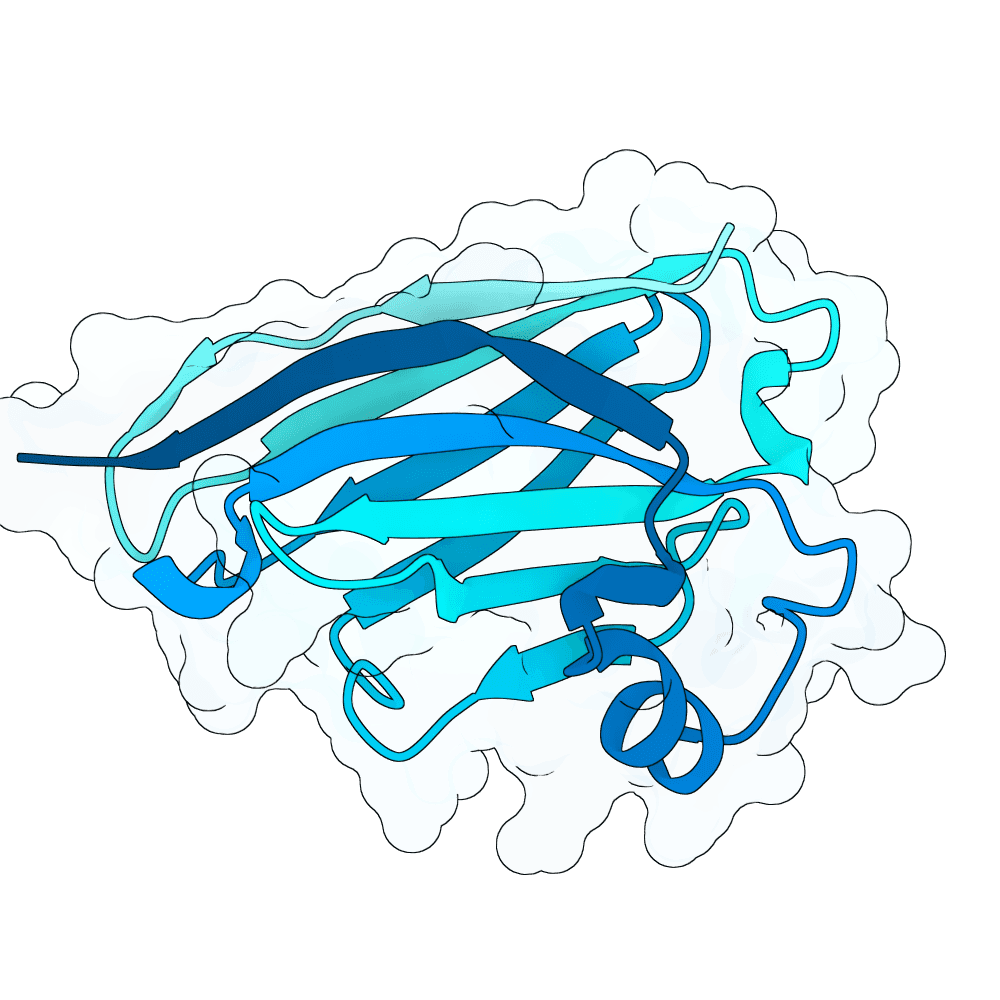
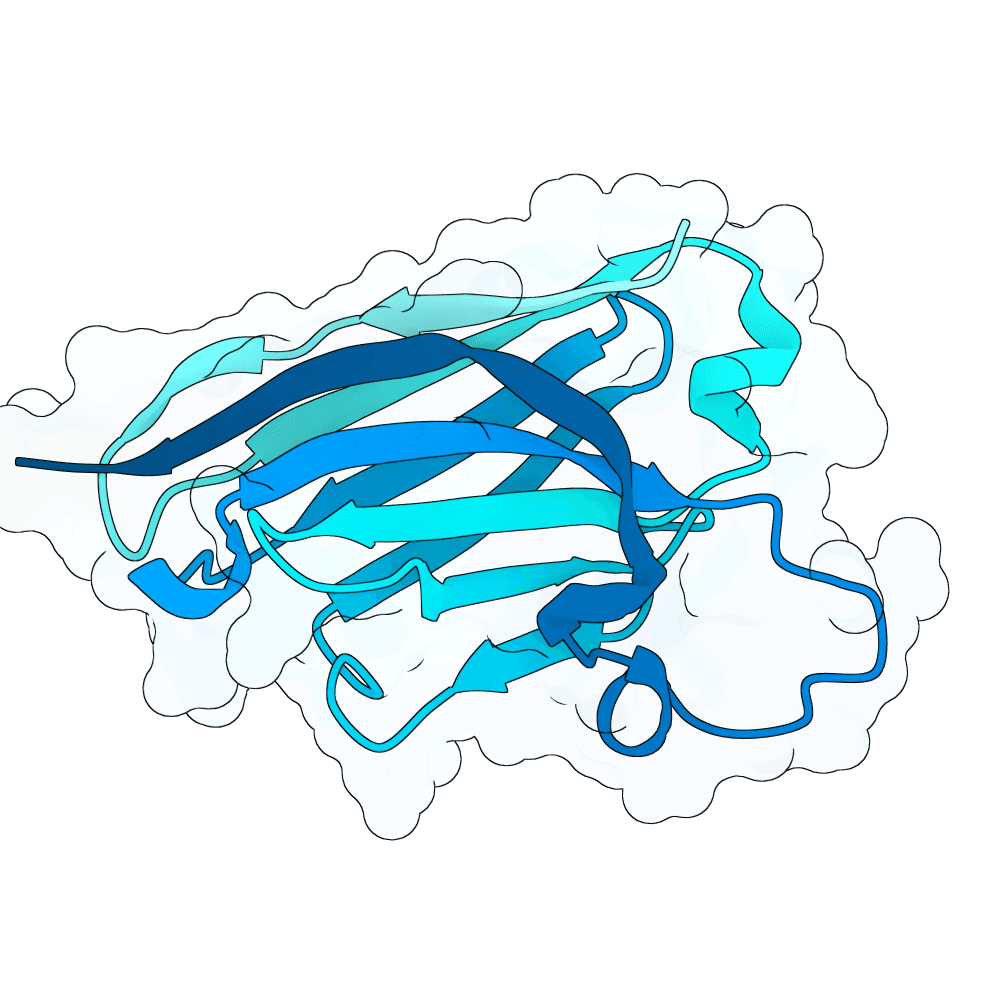
We use BoltzGen to design a nanobody from the scaffold, refold and estimate ipSAE against the query sequence (blue-highlighted sequence) using Boltz-2, then ranking structures based on custom scores and ipSAE.
Hotspot ID:
- We began with the 2vsm structure provided from Adaptyv, and used BioPython to identify residues in contact with EFNB2 (interaction interface residues were defined as those with carbon atoms within 10 angstroms of the other chain)
- In addition, we focused on a subset of positions shown to affect EFNB2 binding through DMS experiments published by Larson et al. (Larson BB et al, Cell, 2025)
- Finally, we used a PyMol script to identify 3-4 residues that formed a hydrophobic surface as an optimal target
- In the end, we selected the residues: I401, R402, W504 as our hotspots for generating binders
Design using BoltzGen:
- We used BoltzGen to create 10,000 designs using the hotspots defined, and the 4 default nanobody templates provided in the BoltzGen repo.
- However, we adjusted the length of CDRs to the following:
- CDR1: 3-5 aa
- CDR2: 3-5 aa
- CDR3: 7-14 aa
Binder Re-folding:
- After the BoltzGen pipeline was run, all binders passing the minimum filters (400+ in our case) were re-folded using Boltz2.
- The resulting predicted structures and confidence matrices were used to calculate additional scores that were used for final ranking and selection
ipSAE calculation:
- The Boltz2 predicted structures and confidence matrices were used to calculate ipSAE for each design using the ipSAE package from Github using default parameters
Binder Filtering:
- We filtered our 400+ designs based on a simple set of filter thresholds: RMSD_to_target <= 4, RMSD_to_design <= 4, ipTM >= 0.5, n_hotspots_at_interface >= 1 (meaning at least one of the defined hotspots is at the binding interface)
Binder Ranking:
- We employed a similar ranking algorithm to that employed by BoltzGen (Algorithm 2), except with a reduced set of metrics. The metrics:weights are as follows: pTM: 1, ipTM: 1, ipAE: 1, dSASA: 2, h-bonds:2, percent_hotspots: 2 (percent hotspots means how much of the hotspots are in the binding interface)
- As in BoltzGen, ipTM is used as a tie breaker in the assignment of final ranks
Final selections:
- The top 30 ranked binders were then re-ranked by ipSAE, and those with the highest ipSAE scores were selected for submission.